
AI's struggle with Excel: what we learned from evaluating AI agents
TL;DR: AI adoption in finance has lagged the headlines because the first output is rarely close enough to salvage. The only way past "AI models feel unreliable" is to measure quality the way an analyst does — which is what MBABench, an eval for financial spreadsheet work, sets out to do.
The adoption gap
If you've tried using an AI agent to build a financial model, the story usually goes something like this: the agent produces a file, you open it — and within thirty seconds, you're deciding whether to fix it or start over. Most of the time, people start over.
This is the quiet reason AI adoption in finance has been slower than the headlines suggest. The first output is rarely close enough to what you had in mind to be worth salvaging. And once you've decided the gap is too wide, you're not going back to the agent for round two. The friction of explaining what's wrong — cell by cell, formula by formula — usually costs more than just building the model yourself.
What does "close enough" even mean?
The uncomfortable part for people is to define what a "good" Excel model looks like. They struggle because there's no rulebook. Two analysts can build the same DCF with completely different structures and both be excellent. But if you opened ten random workbooks, you could rank them in under a minute without hesitation. You'd know — your instinct is doing the work — but articulating why is tough.
Which is exactly the problem for anyone trying to adopt AI for financial work: you can tell the difference between a good output and a bad one, but you can't hand an AI agent a checklist that reliably produces the good one.
Consider these two real AI attempts at building a financial model:
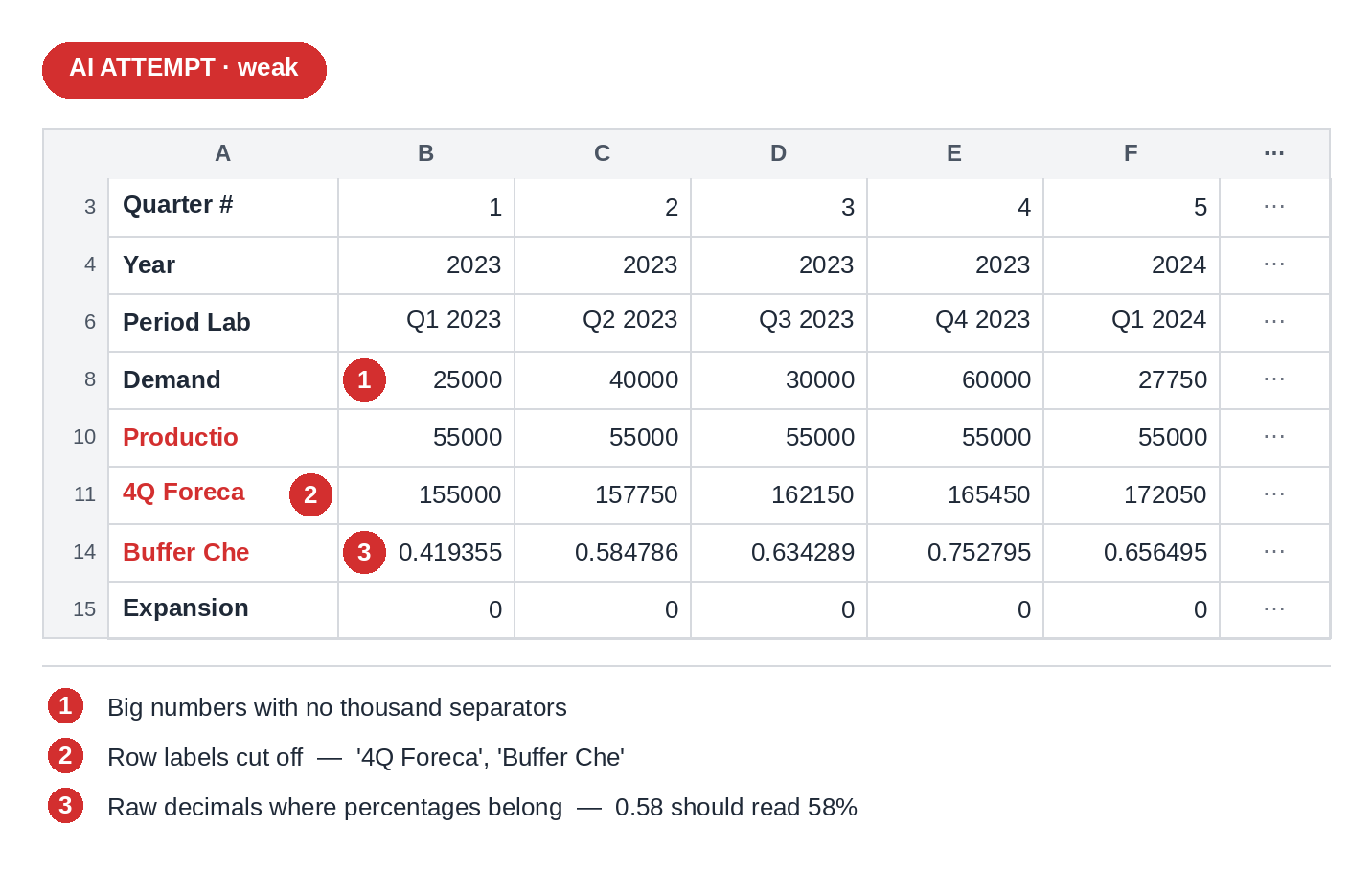
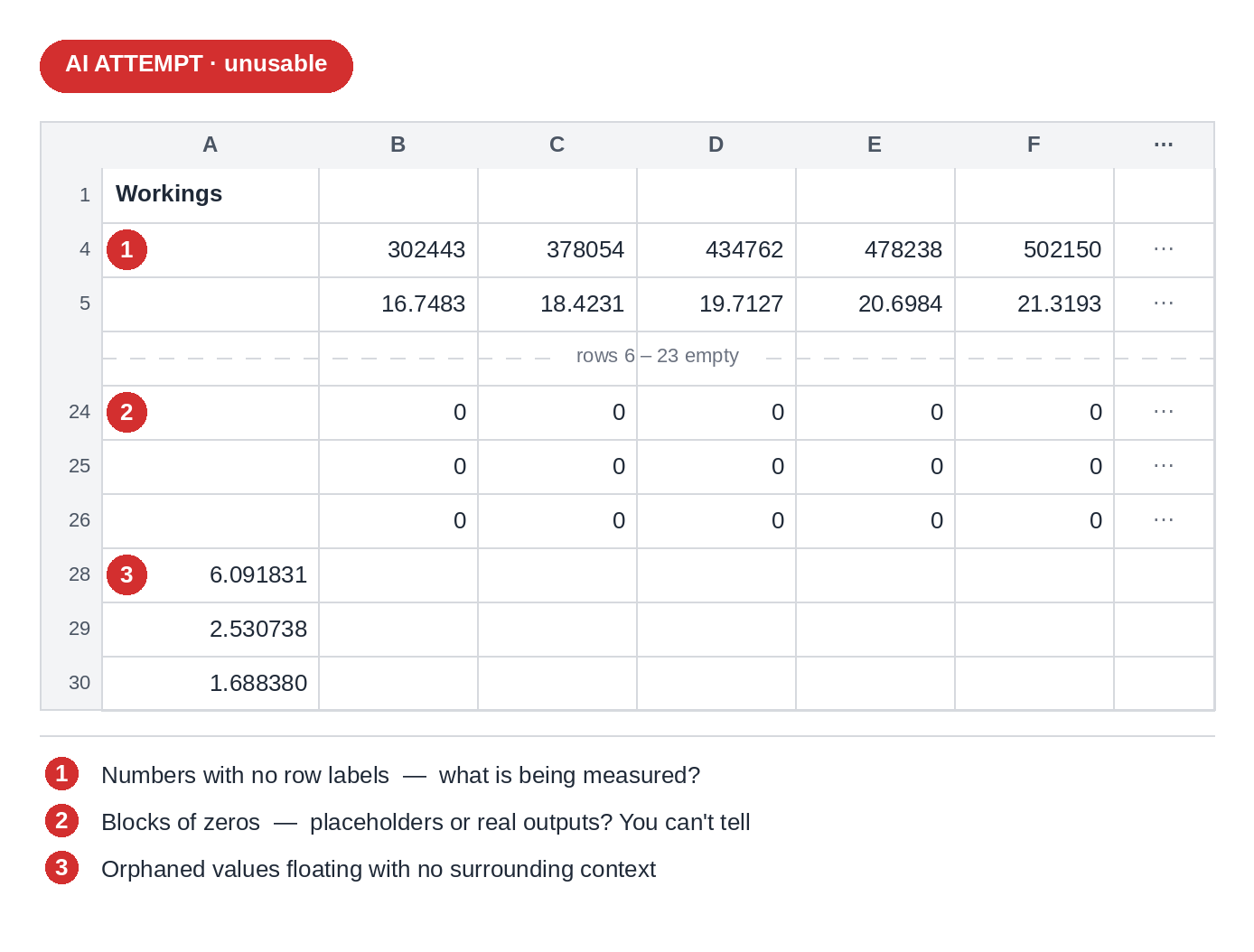
Now compare:
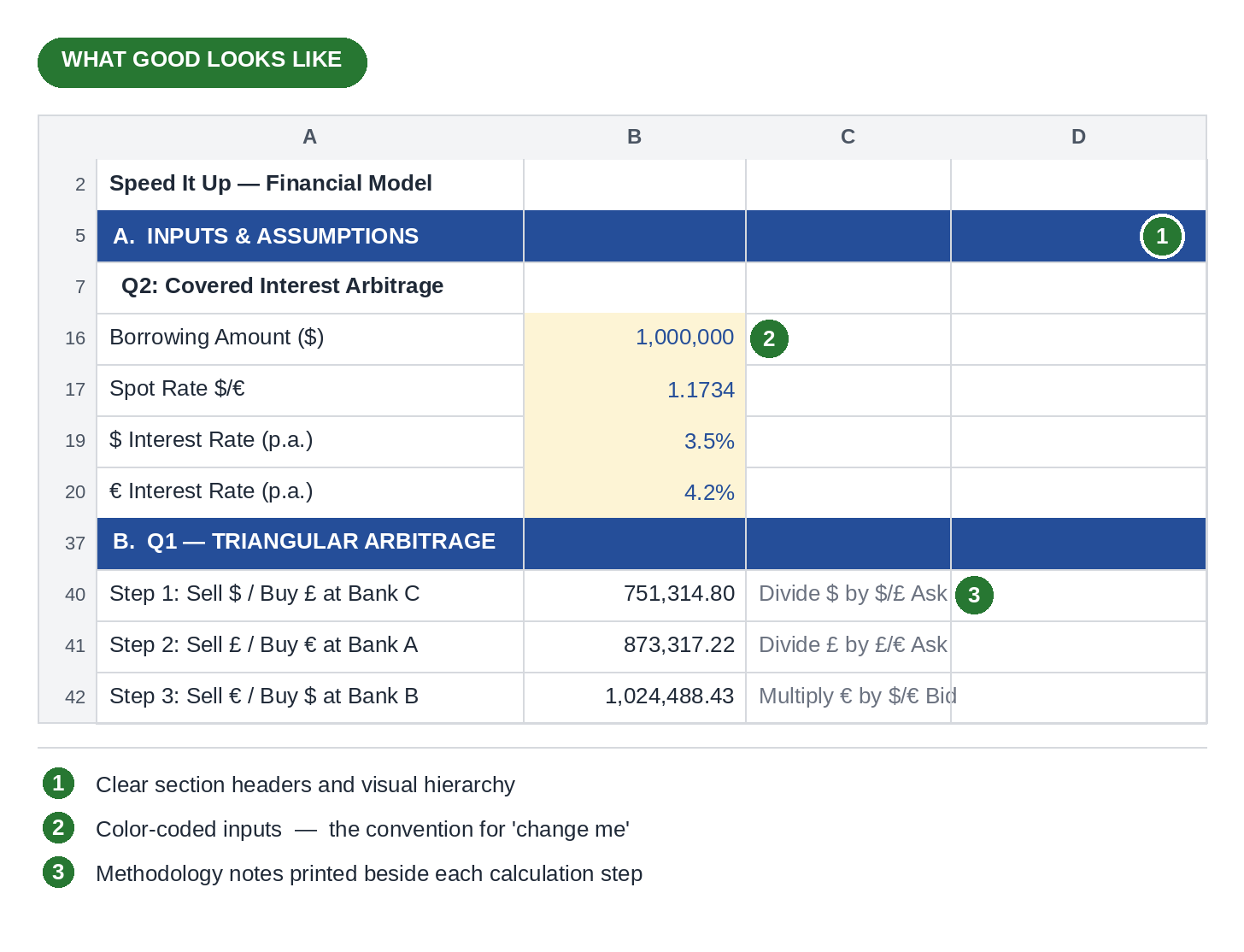
The gap between the first two and the third is about craft — the hundred small decisions a trained analyst makes without thinking, that together make a workbook feel trustworthy.
How do we fix this — where evals come in
This is the gap we set out to measure. The only way to move past "AI models feel unreliable" toward informed adoption decisions is to systematically test them — and that means building an eval (an evaluation framework / benchmark): a structured system that scores AI outputs against the quality standards finance professionals actually care about.
Think of an eval as a codified version of that senior-analyst instinct. Instead of "I'll know it when I see it," an eval gives you a reproducible score across multiple dimensions of quality, so you can compare one model against another — or the same model six months from now against itself today. This matters because frontier models keep changing. Without an eval, every team is starting from scratch with every release, running ad-hoc tests and making adoption decisions on vibes. With one, you have durable infrastructure for deciding what's actually good enough for your workflow.
MBABench, briefly
We built MBABench to apply this approach to financial spreadsheet tasks at scale. It's 196 end-to-end tasks drawn from the Financial Modeling World Cup, ModelOff competitions, and Wall Street Prep — real case studies where the AI receives a brief, a partially-filled template, and has to build a complete, interconnected workbook. Tasks span Valuation & DCF models, 3-statement models, derivatives pricing, debt & equity models, FP&A models, and many more.
The benchmark scores AI agent outputs on three dimensions that together capture what analysts actually care about:
- Accuracy. Did it get the right answers? Are starting values correct?
- Formula Quality. Is the logic traceable and robust? Are inputs referenced from cells or hardcoded?
- Formatting. Is the workbook readable and professional? Proper number notation?
We weigh these 50 / 35 / 15 — accuracy matters most, then formula robustness, then formatting — though any firm could adjust these weights to match their own priorities. The figure below shows the detailed breakdown of the three core dimensions into their constituents.
Because many of these quality dimensions involve judgement (there's no script that can evaluate "is this structure intuitive?"), we use a validated LLM-based judge to apply the rubric. The judge produces structured evaluations — pinpointing specific cells, explaining what's wrong, and suggesting corrections. We validated the judge against human experts across hundreds of workbooks, and its rankings align closely with what professionals would say.
Here's a real example — the judge evaluating whether a model produced by an AI agent handles edge cases properly:
{
  "check": "Handle edge cases",
  "decision": "Fail",
  "mistakes": [
    {
      "description": "Missing error handling for division by churn rate.",
      "location": "Sheet3!L65",
      "explanation": "The formula divides by a churn rate pulled from the assumptions sheet. If churn were set to 0, this produces a #DIV/0! error. An IFERROR wrapper is needed.",
      "expected": "=IFERROR(K65/J65, 0)"
    }
  ]
}
The judge is the crux of the entire eval. Once you've calibrated it to the point where a senior analyst would agree with its calls, you have a reusable engine — run any AI agent through the same rubric, and you get a precise, comparable breakdown of exactly where it falls short and why.
What the benchmark reveals
We ran twelve frontier agents through MBABench. Here's what the data shows.
Even the best agent scores only 69 out of 100.
Claude Web — Anthropic's Opus model operating through the standard claude.ai chat interface — was the top performer, leading on all three quality dimensions (Accuracy, Formula, and Format). And it still falls well short of a professional bar. The next tier clusters in the high 50s to low 60s: ChatGPT-for-Excel (60.4), Claude-for-Excel (59.0), and ChatGPT Pro (58.7). Everything else drops off steeply — ChatGPT Agent at 31.2, and the API-harness models (Opus, Gemini, GPT, Grok) in the teens, with open-source models like Kimi K2 (14.4) and OLMo (6.8) at the bottom. The frontier is improving fast, but it is not yet ready to hand a finished model to an MD.
The purpose-built spreadsheet agents don't win — the general chat interface does.
This was the most counterintuitive result. The dedicated Excel plug-ins from both Anthropic and OpenAI, built specifically for spreadsheet work, trailed Claude's general-purpose chat interface. A big reason: the Excel agents and ChatGPT Pro frequently hardcode values directly into cells instead of writing the underlying formulas. The numbers are often correct, but the workbook is unauditable and breaks the moment someone changes an assumption — exactly the kind of output a reviewer discards rather than builds on.
The harness matters as much as the model.
Holding the underlying model fixed, Opus scores 69.1 through Claude Web but only 18.2 through our programmatic API harness — a roughly 3.8x gap from the same model. The wrapper around the model — how it reads the sheet, plans, and writes back — drives a huge share of performance. The practical lesson for anyone evaluating AI tools: test the full stack (model + interface + tooling), not just the model name on the box.
Performance collapses as tasks get harder.
This is the finding that matters most for real adoption. Agents do reasonably well on easy tasks that don't require deep financial expertise — but performance degrades sharply once a task demands more than a few chained calculations. Even Claude Web falls from its strong overall showing to 53.4 out of 100 on Medium-Hard tasks, and every agent drops off as difficulty rises. The straightforward work is increasingly automatable; the complex, interdependent modeling that fills a senior analyst's day is exactly where today's agents break down.
The implication for adoption: the agents are already useful for simpler, well-scoped tasks, but the gap to professional-grade work on hard problems is large and systematic. Knowing precisely where that line sits — which tasks an agent can be trusted with and which it can't — is the difference between deploying AI responsibly and deploying it on faith.
Where this goes
The specific gaps we're measuring today will narrow over the next year — new models ship every few months. But the question "is this new model good enough for our work?" will keep getting asked. Evals are the stepping stone from AI experimentation to AI adoption inside finance firms. They turn a vague sense of "this isn't ready" into a precise diagnosis of what's missing and a reliable way to track progress.
MBABench is our contribution to this — built by a team at Columbia Business School at the intersection of finance and machine learning. Professors Hongseok Namkoong and Daniel Guetta lead this work, bridging rigorous ML research with the real-world decision problems that finance professionals face daily.
- 🔗 Explore MBABench: Project Website
- 🔗 Read the paper: MBABench
- 📧 Reach out: Hongseok Namkoong (namkoong@gsb.columbia.edu), Daniel Guetta (guetta@gsb.columbia.edu)